Feeding pumps: how they work and how to use yours
A plain-language guide to enteral feeding pumps — what the pump actually does, the parts, priming and rates, what the alarms mean, and how to recognise your own model.
Written from the clinical sources listed below
On this page
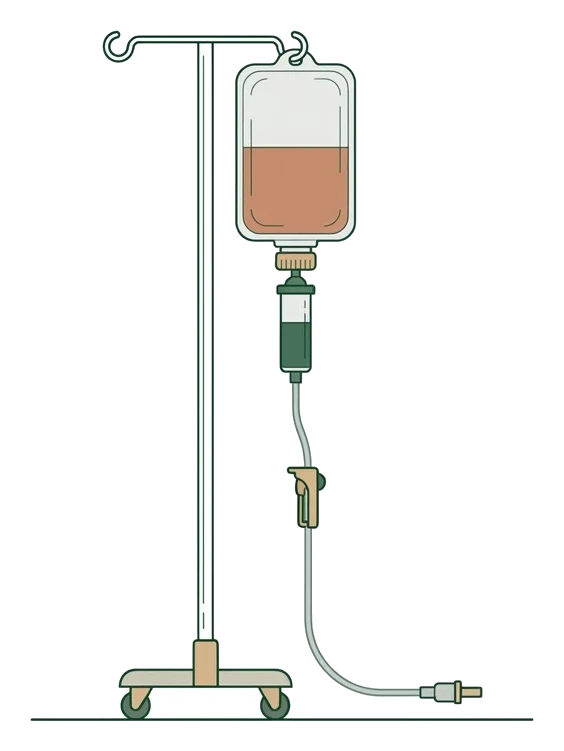
A feeding pump pushes formula through your tube at a set, steady rate instead of letting gravity do it. You fill a bag, prime the tubing so formula runs all the way to the end, load the set into the pump, set a rate in millilitres per hour, and connect. The pump holds that rate and alarms if something blocks or runs out. Your care team sets the rate and volume, not the pump.
- A pump controls the rate. That is its whole job — slower and steadier than gravity or a syringe.
- Priming means running formula all the way to the end of the tubing before you connect, so you are not pushing air in.
- Rates are set in millilitres per hour, and the numbers come from your care team, not from the pump.
- Most alarms mean something simple: an empty bag, a closed clamp, a kink, or a set that is not seated properly.
- Your pump model is whatever your supplier provides. You rarely get to choose it, and they all do the same job.
If a pump has turned up with your supplies, it can look like the most complicated part of tube feeding. It is actually the simplest idea in the whole setup: it moves formula at a steady rate so you don't have to.
Everything else in this guide is detail around that one sentence.
What a feeding pump actually does#
Formula has to get from a bag into your tube. There are three ways to make that happen. You can push it with a syringe. You can hang the bag up and let gravity pull it down. Or you can put the tubing through a pump, which squeezes it in a controlled rhythm and delivers a set amount per hour.
That is the only thing a pump adds: control of the rate. It isn't doing anything clever to the formula, and it isn't monitoring you. It is a very reliable way of delivering, say, 60 millilitres (2 oz) every hour for eight hours without anyone standing there.
The parts, from the top down
Why a pump instead of gravity or a syringe#
Your team will usually suggest a pump for one of a few reasons.
Because faster feeds don't sit well. A syringe feed goes in over a few minutes. For a lot of people that is completely fine. For others it brings nausea, bloating, cramping or reflux, and slowing the same volume down over an hour or two fixes it.
Because the feed runs overnight. If a large part of your nutrition goes in while you sleep, something has to hold a steady rate for eight or ten hours. A pump does that and alarms if it can't.
Because the tube ends in the small intestine. If you have a J tube or the jejunal side of a GJ tube, feeds nearly always run by pump. The small intestine has no reservoir the way the stomach does — it cannot take a large volume at once, so a slow continuous rate isn't a preference, it is how that route works.
Plenty of people use both: a pump overnight, a syringe for a daytime feed.
The parts, and what each one is for#
The one thing worth understanding is why the bag hangs above the pump. The pump can move formula along, but it is working with gravity rather than against it. A bag below the pump makes everything harder and causes alarms.
Priming: the step people skip#
Priming means running formula through the tubing until it reaches the far end, before you connect anything to yourself.
Priming, in three moments
It matters because of what is in the tubing before you start: air. If you connect an unprimed set, the pump dutifully delivers that air into your stomach first. That is uncomfortable, it can make you burp and bloat, and it tends to set off alarms once the pump senses the change.
So: fill the bag, close the clamp, hang it up, then open the clamp and let formula run through into a sink or onto a towel until it reaches the end. Close the clamp again, load the set into the pump, and only then connect.
Some pumps have a prime button that does this for you. If yours does, use it — it is the same process, done by the machine.
Setting a rate#
Rates are set in millilitres per hour. If your team says 2 oz (60 mL) an hour over eight hours, the pump delivers about 16 oz (480 mL) across the night.
Two numbers usually matter: the rate, which is how fast, and the dose or volume, which is how much in total before the pump stops. Some pumps also let you set a feed as a series of smaller boluses with gaps between them.
These numbers come from your care team. They are worked out from your nutrition needs and how well you tolerate feeds, and they are the one part of this that should never be guessed at or adjusted on a hunch. If a rate is not working — if it leaves you uncomfortable, or you are not getting through the volume — that is a conversation with your dietitian, not a dial to turn.
Recognising your pump#
You almost certainly did not choose your pump. Your supplier or hospital provides whatever they stock, and the model you have says nothing about the quality of your care. They all do the same job.
It is still useful to know which one is yours, because the manual, the sets and the spare parts are all model-specific, and a supplier will ask.
Kangaroo Joey. Compact, with a screen on the front and a column of buttons down one side. One of the most widely supplied pumps.
Kangaroo ePump. A larger, boxier unit from the same family. Fine on a pole; heavier to carry.
Kangaroo OMNI. A more recent Kangaroo with a touchscreen rather than a button panel.
Kangaroo Connect. The newest of the Kangaroo family.
Moog Infinity. Notably small and light, and designed to be carried. The teal-cased one.
Moog Infinity, orange. The same pump in a different colourway. If yours is orange, it is still an Infinity.
We have deliberately not listed rates, battery life or set compatibility per model. Those vary by version and go out of date, and getting them wrong would be worse than not saying. Your pump's own manual is the source of truth, and your supplier will send a replacement if you no longer have it.
What the alarms mean#
An alarming pump is almost never an emergency. It is a machine telling you it cannot do what it was asked.
Work down from the bag, in this order:
The alarm checklist
Is there formula left?
The most common alarm by far is simply an empty bag. Check the bag before anything else.
- You are struggling to breathe, or you breathe in formula and start coughing or choking
- You develop sudden chest pain or severe abdominal pain during a feed
- You are vomiting repeatedly and cannot keep your airway clear
- The pump alarms repeatedly even after you have checked the bag, the clamps, the tubing and the set
- You cannot get the feed in and have missed more than one scheduled feed
- Feeds that used to be comfortable now cause pain, bloating or reflux at the same rate
- The pump is damaged, will not hold a charge, or stops mid-feed
Everyday care#
Cleaning. The pump itself is wiped down, not washed — it is an electrical device. Wipe the outside and the set channel with a damp cloth, and keep formula out of the mechanism. The bag and tubing are single-use and go in the bin at whatever interval your team specified.
Batteries. Most pumps run on mains power and switch to battery when unplugged. Keep it charged between feeds and ask your supplier what the real battery life is on a full charge, because that determines how long you can be out.
Travel. Pumps are made to move. A supplier-provided backpack carries the pump and bag together, and the pump keeps running while you walk around. Take the charger, and for longer trips, ask about spare sets.
What to ask at your next appointment#
If the pump has just arrived and nobody has gone through it with you, these are the questions worth having answers to: what rate and total volume am I set to, how often do I change the set, how long does the battery last, who do I call when it alarms out of hours, and can I have a copy of the manual.
None of those are difficult questions, and a supplier or home enteral nutrition team will expect them.
Frequently asked questions
- ESPEN practical guideline: Home enteral nutrition — European Society for Clinical Nutrition and Metabolism (ESPEN), 2022
- Enteral nutrition clinical resources — American Society for Parenteral and Enteral Nutrition (ASPEN)
- Education and peer support for home tube feeding — The Oley Foundation
This article is educational and is not medical advice. It is written from the published clinical sources listed above, not from your own chart. Every person and every tube is different — always follow the instructions of your own care team, and call them (or emergency services) if something feels wrong.