Feeding tubes for children: a parent's starter guide
Why children need feeding tubes, why it's usually a nose tube first, how to protect your child's interest in eating, and what weaning off the tube actually looks like.
Written from the clinical sources listed below
On this page
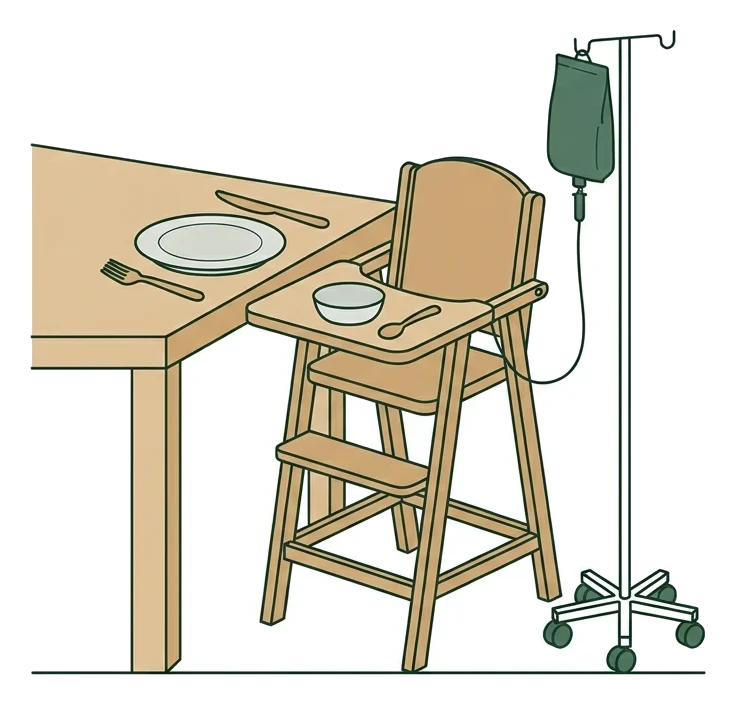
Children need feeding tubes for different reasons than adults — usually because they are too young or too unwell to take in enough to grow, not because swallowing is permanently unsafe. A nose tube usually comes first; if support will last months, a button in the tummy is often kinder. The most important thing is keeping your child's mouth in use.
- Most children get a tube to grow, not because they can never eat — the goal is usually nutrition now, mouth skills in parallel.
- A nose tube comes first in most cases. It's placed without surgery and comes out the moment it isn't needed.
- If support is likely to last months, a button is often kinder than a long-running nose tube — and is linked to fewer problems with oral aversion.
- Protect the mouth from day one: tastes, mouthing, and being at the table. Tube dependency grows out of a mouth that stopped being used.
- Weaning is a real, planned goal — in one review of weaning programs, 83% of children weaned at least partially, and 41% came off entirely.
Almost every parent arrives at this page the same way: someone used the words "feeding tube" about your child, and the room got quieter. It helps to know early that children's tubes are a different story from the adult ones you may have seen. Most children get a tube in order to grow, not because they will never eat — and a great many of them come off it.
Here's the shape of it: why it's happening, what the choices are, and the one thing that matters most while the tube is in.
Why children need tubes, and why it's different#
Adults usually get a feeding tube because something has gone wrong with swallowing. Children usually get one because the arithmetic of growth stopped working.
A premature baby may simply not be ready yet: sucking, swallowing and breathing have to happen in a coordinated rhythm, and that coordination is a developmental milestone like rolling over — it arrives on its own schedule. Other children take far longer over a feed than they can sustain, or burn more energy than they can replace because of a heart or lung condition, or have a neurological condition that makes feeding slow and tiring. Some have a mouth or gut that needs time to heal.
What these have in common is that the child needs calories now, while the underlying thing is being treated or outgrown. The tube buys that time.
It is worth separating two questions that often get tangled: can my child take in enough right now? and will my child eat by mouth in the long run? The tube answers the first. The second is usually still open, and what happens in the months on the tube influences it more than the tube itself does.
Nose tube first, button later#
Most children start with a soft tube through the nose. It needs no procedure, it can be placed and replaced easily, and it comes out the moment it isn't needed.
If feeding support looks like it will run for months rather than weeks, teams raise the idea of a buttonA low-profile gastrostomy. A small device sitting flat against the tummy, opening directly into the stomach, with nothing on the face. Feeding sets clip on when needed and come off in between.. Parents often hear this as an escalation — a nose tube feels temporary and reversible, a procedure does not.
In practice, for a child who needs months of support, the button is usually the gentler option. The face stays free. There's nothing taped to a cheek, nothing to catch on a sleeve, nothing to pull out at 3am. Bathing and carrying get easier. And it matters for feeding skills: earlier placement of a gastrostomy is associated with fewer complications such as oral aversion than prolonged nose-tube feeding, precisely because a tube running past the mouth and throat for months is its own obstacle to wanting anything near your face.
The same child, two ways of being fed
The thing that matters most: keep the mouth in the game#
If you take one thing from this page, take this.
That's tube dependency, and it has a name because it is common enough to need one. It develops quietly, through a chain that is easy to miss while you are busy keeping a child alive: nutrition arrives on a schedule, so true hunger is rarely felt; most things that happen near the face are medical rather than pleasant; and the mouth gets used less and less, so the skills fade.
The counter to it is ordinary and relentless:
Keeping the mouth active while the tube feeds
Offer tastes whenever your team allows it
Even a smear on a dummy or a fingertip keeps flavour and mouth movement alive. Ask what is safe for your child before you start.
If your child has already started refusing, that isn't a failure and it isn't permanent — but raise it now rather than at the next routine appointment. The person you want is a feeding therapist.
What a feeding therapist actually does
The title covers two professions: a speech-language pathologist or an occupational therapist who specialises in feeding. Either way the work is not what most parents expect — very little of it is about getting food in.
Early sessions are usually about making the area around the mouth a neutral, unthreatening place again, because for a tube-fed child it often hasn't been. From there it moves to the mechanics: how your child sits, how a spoon approaches, which textures their mouth can actually manage today rather than which ones you wish it could. Progress is measured in tolerance before it is ever measured in volume.
They are also the person who tells you when to stop pushing on a given day — which, for most parents, turns out to be the more useful half of the job.
Growth is the scoreboard, not volume#
Parents often measure the day in millilitres: how much went in, how much came back up, whether the number matched the plan. It's an exhausting way to live and it isn't the measure the team is using.
What matters is the growth curve over weeks — weight, length and head circumference, tracked on a chart. A single bad day moves nothing on that chart. Ask to see it, and ask what trend they want. It converts a thousand anxious daily numbers into one question you can actually answer.
Children also tend to need more venting than adults — releasing trapped air through the tube — because swallowed air, crying and smaller stomachs combine badly. If feeds are coming with arching, squirming or retching, ask about venting and about slowing the rate before assuming the formula is wrong.
Weaning is the plan, not the dream#
Weaning off a tube is an active, structured process, and it works more often than most parents are told at the start. In a review of pediatric weaning programs, 83% of children weaned at least partially, and 41% came off the tube completely.
It is driven by hunger — carefully, with the team, by adjusting what the tube provides so that appetite has room to appear — alongside feeding therapy to rebuild skills and confidence. It is not something to attempt by reducing feeds on your own; done without supervision it risks growth. But it is reasonable to ask, early and more than once: what would weaning look like for our child, and what has to be true before we start?
- Serious trouble breathing, or choking that does not clear when the feed stops
- The tube or button has come out and the opening is closing — this is time-sensitive in children
- A hard, swollen, very tender tummy, or blood in what comes out of the tube
- Fewer wet nappies or dry nappies, no tears when crying, or unusual sleepiness — children dehydrate faster than adults
- Repeated vomiting, retching or arching with feeds
- The site is red, spreading, hot, smelly, or leaking more than usual
- Your child has started refusing tastes or turning away from the spoon
- Weight has stalled or dropped between appointments
What to ask at the next appointment#
Four questions get you further than any amount of reading:
- What exactly is the tube solving for our child? The answer shapes everything else.
- What has to be true before the tube can come out? This turns a vague future into criteria.
- Who is our feeding therapist? If there isn't one, ask for a referral now rather than later.
- Can we have a written feeding plan? You will need it for daycare, school, grandparents and the first night someone else does a feed.
A feeding tube in childhood is usually a bridge, not a destination. The job while you're on it is to keep your child fed, keep their mouth interested, and keep asking what the far side looks like.
Frequently asked questions
- Development, prevention, and treatment of feeding tube dependency — European Journal of Pediatrics
- Pediatric gastrostomy feeding tube weaning strategies: a scoping review — PMC / National Library of Medicine
- Prevention and treatment of tube dependency in infancy and early childhood — ICAN: Infant, Child, & Adolescent Nutrition
- Home tube feeding resources for families — The Oley Foundation
This article is educational and is not medical advice. It is written from the published clinical sources listed above, not from your own chart. Every person and every tube is different — always follow the instructions of your own care team, and call them (or emergency services) if something feels wrong.