Types of feeding tubes explained: NG, G/PEG, GJ, and J
A plain-language comparison of the main feeding tube types — nasogastric (NG), gastrostomy (G/PEG), gastrojejunostomy (GJ), and jejunostomy (J) — and what each one means for daily life.
Reviewed by the Lugano Health team
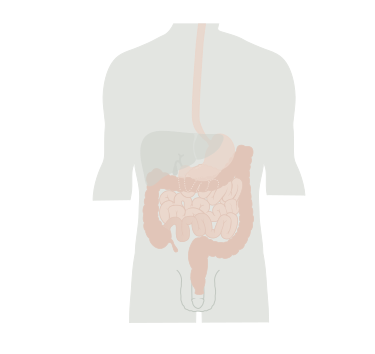
Feeding tubes are named for where they deliver food. NG/NJ tubes go through the nose and are usually short-term. G tubes (including PEG tubes) go directly into the stomach and are common for longer-term feeding. J tubes go into the small intestine (jejunum), and GJ tubes can reach both the stomach and small intestine. Your care team chooses the type based on your anatomy, how long you'll need it, and how well your stomach works.
- Tubes are named by destination: nose (NG/NJ), stomach (G/PEG), or small intestine (J/GJ).
- NG tubes are usually short-term; G/PEG tubes are common for longer-term feeding.
- J and GJ tubes deliver into the small intestine, used when the stomach needs to be bypassed.
- The 'best' type is the one that fits your body and needs — a decision for your care team.
If the letters feel like alphabet soup — NG, PEG, G, GJ, J — here's the trick that makes it all click: feeding tubes are named for where they deliver food. Once you know the destination, the name tells you the story.
The two questions that define every tube
- How does it get in? Through the nose, or directly through the abdomen.
- Where does it end? In the stomach, or further along in the small intestine.
That's it. Every type below is just a combination of those two answers.
NG and NJ tubes — through the nose
- NG (nasogastric): nose → stomach.
- NJ (nasojejunal): nose → small intestine.
These go in without surgery and are usually for shorter-term feeding — during a hospital stay or a recovery period. Because they're visible and can be uncomfortable over time, they're generally not the long-term choice.
G tubes and PEG tubes — into the stomach
- G tube (gastrostomy): delivered directly into the stomach through a small opening in the abdomen.
- PEG is a G tube placed using an endoscope — so a PEG is a G tube; the term just describes how it was placed.
G/PEG tubes are common for longer-term feeding. Many people find them easier to live with than a nasal tube because there's nothing on the face.
J and GJ tubes — into the small intestine
- J tube (jejunostomy): delivers nutrition into the jejunum (small intestine), bypassing the stomach.
- GJ tube (gastrojejunostomy): a combination tube that can reach both the stomach and the small intestine — often used when someone needs stomach venting and small-bowel feeding.
These are chosen when the stomach can't be used safely — for example, with severe reflux, slow stomach emptying, or a high risk of food going into the lungs (aspiration).
Quick comparison
| Tube | Route | Ends in | Typically used for |
|---|---|---|---|
| NG / NJ | Nose | Stomach / small intestine | Short-term feeding |
| G / PEG | Abdomen | Stomach | Longer-term feeding |
| J | Abdomen | Small intestine | Bypassing the stomach |
| GJ | Abdomen | Stomach + small intestine | Venting + small-bowel feeding |
So which one is "best"?
There's no universal winner — each type solves a different problem. The right tube depends on your anatomy, how long you'll likely need it, and how well your stomach works. That's a decision for your care team, and it's worth asking them to explain why they chose yours.
Read more about each type
- What is an NG tube? — the nasal, usually short-term tube
- What is a G tube? — the stomach tube, and buttons vs long tubes
- What is a PEG tube? — a G tube placed with a small camera
- PEG tube vs G tube — what's actually different
New to all of this? Start with Feeding tubes made simple.
Frequently asked questions
- Types of enteral access devices — American Society for Parenteral and Enteral Nutrition (ASPEN)
- Understanding your feeding tube — The Oley Foundation
This article is educational and is not medical advice. Every person and every tube is different — always follow the instructions of your own care team, and call them (or emergency services) if something feels wrong.