Low-profile feeding tube buttons (MIC-KEY and others), explained
A plain-language guide to low-profile feeding tube buttons like the MIC-KEY — what they are, how extension sets work, sizing, and routine changes.
Reviewed by the Lugano Health team
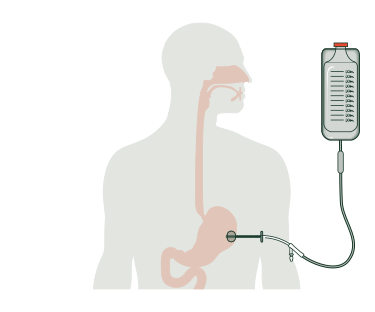
A low-profile feeding tube button is a short gastrostomy device that sits nearly flat against the skin instead of a long tube hanging outside. To feed or give medicine, you snap on an extension set, then disconnect it afterward. The MIC-KEY is one well-known example, but several manufacturers make similar buttons. They're a common choice once the stoma has healed, because they're discreet and tuck away easily.
- A button is a short, low-profile G tube that sits flat on the skin instead of hanging out.
- You connect an extension set to feed or give medicine, then disconnect it when you're done.
- MIC-KEY is one example; buttons come in balloon and non-balloon styles.
- Your care team measures the size (French width and stoma length) and handles routine changes.
If you've heard someone mention a "button" or a "MIC-KEY," they're talking about a low-profile feeding tube. It does the same job as a longer G tube — it just sits differently on the body, and that small difference makes a real difference to daily life.
What a button actually is
A button is a short gastrostomy tube that sits nearly flat against the skin, with a small port on top. Instead of a long tube dangling outside your clothes, there's just a discreet cap you can tuck away.
To feed, flush, or give medicine, you snap on an extension set — a short length of tubing with a connector — and then disconnect it when you're finished. Between uses, the button stays capped and flush against the skin.
MIC-KEY and other examples
MIC-KEY is one well-known brand of low-profile button, which is why people sometimes use the name to mean any button. But several manufacturers make similar low-profile G tubes, and they aren't all interchangeable. The one you have is the one to follow — check the packaging, or ask your team what yours is.
Balloon vs non-balloon
Buttons are held inside the stomach one of two ways:
- Balloon-style — a small water-filled balloon just inside the stomach holds it in place. These are usually changed on a routine schedule.
- Non-balloon (bumper) style — a soft internal bumper holds it. These tend to stay in longer and are typically changed by your care team.
Either way, the same rule applies to every G tube: never pull or tug on it.
You need an extension set to use it
Because a button has no long tube of its own, you can't feed or give medicine without an extension set. These come in different styles (some are straight, some have a right-angle connector), and they're matched to your button. Modern connectors follow the ENFit safety standard, which is designed to prevent feeding tubing from being connected to the wrong thing. Keep a couple of spares — see Feeding tube supplies: what you actually need.
Why people like buttons
- Discreet — sits flat and hides easily under clothing.
- Tucks away — nothing hanging to catch on things.
- Simpler between feeds — capped and out of the way when not in use.
Buttons are a common choice once the stoma has healed. Right after placement, many people start with a longer tube first; a button often comes later. Whether and when a button suits you is your care team's call.
Sizing and routine changes
The French size and stoma length that fit you are measured by your care team, and routine button changes are done or supervised by them. Don't try to change or resize a button on your own unless you've been specifically trained and told to.
Two measurements define a button:
- French size — how wide the tube is.
- Stoma length — how far it needs to reach from the stomach wall to the skin.
Both are chosen by your care team, and they can shift over time (weight changes are a common reason), so the fit is re-checked at routine changes.
When to call your care team
Reach out if you notice:
- The button won't flush, or the extension set won't connect properly
- Leaking around the button, or the balloon seems to have deflated
- Redness, swelling, warmth, new pain, or moist bumpy tissue at the site
- The button feels loose, too tight, or has come out — treat a button that has fallen out as time-sensitive and see Your feeding tube fell out or moved: what to do now
For the bigger picture, start with What is a G tube? and Feeding tubes made simple.
Frequently asked questions
- Gastrostomy and tube feeding — patient resources — American Society for Parenteral and Enteral Nutrition (ASPEN)
- Instructions for use for your specific button — Device manufacturer IFU
This article is educational and is not medical advice. Every person and every tube is different — always follow the instructions of your own care team, and call them (or emergency services) if something feels wrong.