PEG tube vs G tube: what's the actual difference?
A clear, plain-language comparison of PEG tubes and G tubes — what's the same, what's different, and why the two words are often used to mean the same thing. For patients and caregivers.
Reviewed by the Lugano Health team
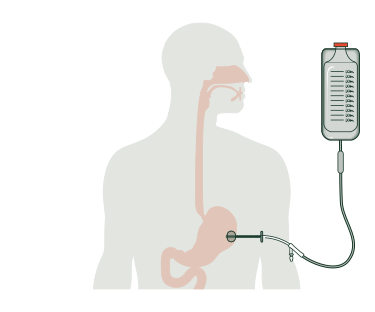
A PEG tube is a type of G tube. Both are gastrostomy tubes that deliver nutrition, fluids, and medicine directly into the stomach. The only real difference is how the tube is first placed: PEG (percutaneous endoscopic gastrostomy) means it was placed using a small camera through the mouth, while other G tubes can be placed surgically or with imaging guidance. Once healed, they're used and cared for the same way.
- A PEG tube is a kind of G tube — not a competing, separate device.
- The difference is the placement method, not where the tube ends up (both feed into the stomach).
- Day-to-day care — flushing, feeds, and site care — is the same for both.
- In everyday conversation, many people use PEG and G tube interchangeably, and that's usually fine.
This is one of the most common feeding-tube questions, and the answer is reassuringly simple: a PEG tube is a type of G tube. They're not two rival devices — one is a category, and the other is a member of that category.
The short answer
- G tube (gastrostomy tube) — any feeding tube that goes directly into the stomach through a small opening in the abdomen.
- PEG tube (percutaneous endoscopic gastrostomy) — a G tube that was placed using a small camera (an endoscope) passed through the mouth to guide it into position.
So "PEG" tells you how the tube was put in. "G tube" tells you where it ends up. Because a PEG ends up in the stomach, a PEG is a G tube.
What's the same
For the person living with the tube, almost everything:
- Both deliver nutrition, fluids, and medicine into the stomach.
- Both are cared for with the same routines — flushing, feeds, and site care.
- Both can be a longer external tube or, later, a low-profile button.
- Both are held in place inside by a balloon or a bumper — so you never pull on either.
What's different
Really just one thing: the placement method.
| PEG tube | Other G tubes | |
|---|---|---|
| What it feeds into | Stomach | Stomach |
| How it's placed | Endoscope (camera) through the mouth guides it in | Surgically, or with imaging (X-ray/ultrasound) guidance |
| Typical use | Very common for longer-term feeding | Used when surgery or imaging placement fits the situation better |
| Day-to-day care | Same | Same |
Your care team chooses the placement method based on your anatomy, why you need the tube, and whether it's being done alongside another procedure.
So which one do I have?
If someone placed your tube with a camera through your mouth, it's a PEG — which is also a G tube. If it was placed surgically or with imaging, it's a G tube placed a different way. Either way, the tube on your abdomen does the same job, and the care is the same.
If you're not sure which you have or how it's held in place, that's a great, specific question for your care team — and knowing the answer makes changes and troubleshooting easier.
Learn more
Frequently asked questions
- Gastrostomy and tube feeding — patient resources — American Society for Parenteral and Enteral Nutrition (ASPEN)
- Understanding your feeding tube — The Oley Foundation
This article is educational and is not medical advice. Every person and every tube is different — always follow the instructions of your own care team, and call them (or emergency services) if something feels wrong.