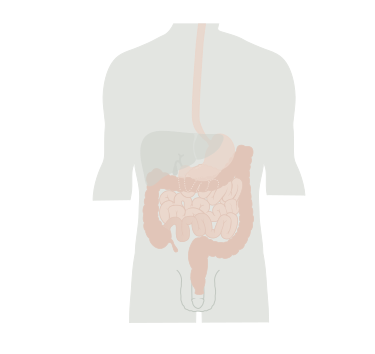
What is a G tube? (gastrostomy tube, explained)
A plain-language explanation of G tubes — what gastrostomy means, what the tube does, the difference between long tubes and low-profile buttons, and how daily care works. For patients and caregivers.
Reviewed by the Lugano Health team
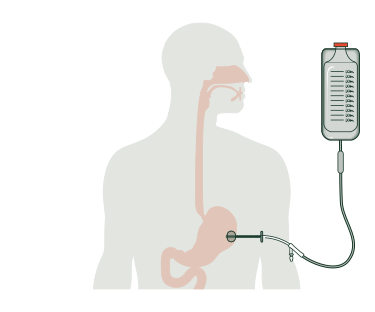
A G tube (gastrostomy tube) is a feeding tube that goes directly into your stomach through a small opening in the abdomen, called a stoma. It delivers nutrition, fluids, and medicine, and is commonly used for longer-term feeding. G tubes come in two main styles: a longer tube that hangs outside, and a low-profile button that sits flat against the skin. A PEG tube is one type of G tube.
- Gastrostomy simply means an opening into the stomach — a G tube feeds through that opening.
- G tubes are common for longer-term feeding and sit on the abdomen, not the face.
- They come as a longer external tube or a low-profile button that sits flush with the skin.
- A PEG tube is a type of G tube — the difference is only how it was placed.
A G tube can look intimidating the first time you see one. But the idea behind it is simple, and once you know the two or three things that matter, the rest falls into place.
What "gastrostomy" means
Gastrostomy just means an opening into the stomach. A G tube (short for gastrostomy tube) is a feeding tube that uses that small opening — called a stoma — to deliver food straight to where it needs to go.
The opening is on the abdomen, not the face, which is one reason many people find a G tube easier to live with than a nasal tube long term.
What a G tube does
A G tube carries nutrition, fluids, and medicine directly into the stomach. Your stomach and intestines then do their normal work — the tube is only the delivery route.
G tubes are common for longer-term feeding, whether that's months or years, and for some people alongside eating or drinking some by mouth (whether that's safe for you is a decision for your care team).
The end you connect to
Where you attach syringes, feeding sets, or medicine. Some G tubes have a low-profile button here instead of a long tube.
Tap a number to learn about each part. Your device may look slightly different.
The two main styles
G tubes generally come in one of two forms:
- A longer tube that hangs outside the body — easy to connect to, and often used right after placement.
- A low-profile "button" that sits flat against the skin, with a small port you attach an extension set to for feeds. Buttons are discreet and tuck away under clothing, which many people prefer once the site has healed.
Both do the same job. Which one you have depends on your situation and your team's plan.
How it stays in place
Most G tubes are held in the stomach by either a small water-filled balloon or a soft internal bumper just inside the stomach wall. That's why you should never pull or tug on the tube. Balloon-style tubes are often changed on a routine schedule — your team will tell you how yours is held and when it's due to be replaced.
Is a PEG tube a G tube?
Yes. A PEG tube is a type of G tube — the term describes how it was placed (with a small camera), not a different destination. See PEG tube vs G tube: what's the actual difference? and What is a PEG tube?.
Daily care
Living with a G tube mostly means a few repeatable routines:
- Flushing with a little water before and after feeds and medicines. See How to flush a feeding tube.
- Site care — keeping the skin around the stoma clean and dry and watching for changes. See Caring for your feeding tube site.
- Feeds on your team's schedule, by syringe, gravity, or pump.
When to call your care team
Reach out if you notice:
- The tube won't flush or you feel strong resistance
- Leaking around the stoma, or redness, swelling, warmth, or new pain
- Granulation tissue (moist, red, bumpy tissue at the site)
- The tube has moved, or fully come out — treat this as time-sensitive and see Your feeding tube fell out or moved: what to do now
For the full picture, start with Feeding tubes made simple.
Frequently asked questions
- Gastrostomy and tube feeding — patient resources — American Society for Parenteral and Enteral Nutrition (ASPEN)
- Education and peer support for home tube feeding — The Oley Foundation
This article is educational and is not medical advice. Every person and every tube is different — always follow the instructions of your own care team, and call them (or emergency services) if something feels wrong.