Dobhoff tubes: the complete guide
Everything about your Dobhoff tube in one place: what it is, how it's placed and checked, daily feeding and flushing, the nasal bridle, troubleshooting, and when it's time for something longer-term.
Written from the clinical sources listed below
On this page
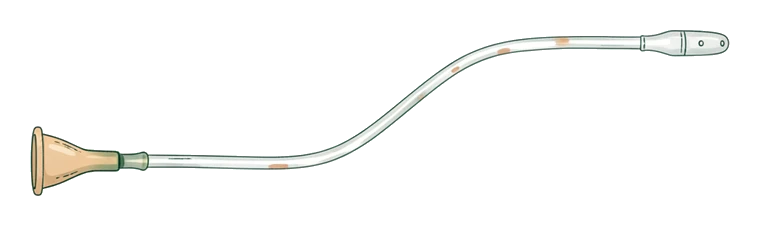
A Dobhoff tube is a thin, soft feeding tube that goes in through your nose and ends in your stomach or small intestine. It's a short-term tube — typically used for days to a few weeks — placed by a clinician and confirmed with an X-ray before first use. You feed and take medicines through it, flush it with water before and after everything, and protect it from being pulled out. If you need tube feeding for longer, your team will usually talk with you about a more permanent tube.
- A Dobhoff is a small, soft nasal feeding tube for short-term use — more comfortable than the stiff tubes used for stomach drainage, and meant only for feeding and medicines.
- Nothing goes through a new or re-inserted tube until placement is confirmed — an X-ray is the standard check.
- Flush with 1 oz (30 mL) of water before and after every feed and medicine; a Dobhoff's narrow bore clogs easily.
- If the external marking has moved, or you cough, choke, or hear gurgling during a feed, stop and call — never keep feeding through a tube that might be out of place.
- Most Dobhoffs stay in for up to about 4–6 weeks; longer than that and your team will usually discuss a G-tube.
If you or someone you love has just been given a Dobhoff tube, here's the reassuring version first: it's one of the gentlest feeding tubes there is, it's temporary by design, and the daily routine is simple once you've done it twice. This guide walks through all of it — what the tube is, how it's placed, feeding and flushing, the bridle that keeps it safe, what can go wrong, and what comes after.
What a Dobhoff tube actually is#
A Dobhoff tube is a nasoenteric feeding tube"Naso" for nose, "enteric" for gut. It just means a feeding tube that goes in through the nose and ends somewhere in the digestive tract.: a long, very thin, soft tube that enters through one nostril, runs down the back of the throat and the esophagus (the food pipe), and ends either in the stomach or a little further along, in the first part of the small intestine. "Dobhoff" is the name that stuck from its inventors — Dr. Dobbie and Dr. Hoffmeister — and you'll hear clinicians use it for almost any soft, small-bore nasal feeding tube.
Three design details matter to you:
- It's narrow and soft. Much thinner than the stiff tubes used to drain stomachs in the hospital — which is why it's comfortable enough to live with, and also why it clogs more easily if it isn't flushed well.
- The tip is weighted. A small, smooth weight helps the tube travel to the right place and stay there.
- It arrives with a thin wire inside. That removable wire (the stylet) stiffens the tube only for insertion. Once placement is confirmed the wire comes out, and it is never put back in while the tube is in you — re-inserting the wire blind can poke through the soft tube.
A Dobhoff is for feeding and medicines only. It can't vacuum the stomach out the way the larger double-channel tubes do — so if you had one of those big stiff tubes earlier in a hospital stay, the Dobhoff that replaced it is a different, far more comfortable tool with a different job.
Why the guidewire never goes back in
The wire (your team may call it a stylet) is stiff enough to steer a very floppy tube down the right pipe. Once the tube is in and confirmed, the wire comes out and stays out. Pushing it back down a tube that is already inside you is dangerous for one specific reason: the wire cannot tell the difference between the inside of the tube and a side hole near its tip. If it finds a side hole, it can pass through the wall of the tube and into you. This is why re-wiring is a clinician-only procedure done outside the body, and why a tube that has moved gets replaced rather than re-stiffened.
Why your team chose this tube#
A Dobhoff is the usual answer when three things are true: your gut works, you can't safely swallow enough (or anything) by mouth right now, and the problem is expected to be temporary. Common examples are recovering from a stroke while swallowing therapy is underway, head and neck treatment that makes swallowing painful, and illness or surgery recovery where nutrition can't wait for appetite.
Sometimes the tube is deliberately advanced past the stomach into the small intestine — you'll hear post-pyloricThe pylorus is the valve at the exit of your stomach. "Post-pyloric" simply means the tube tip sits past that valve, in the intestine rather than the stomach. — when the stomach empties poorly or reflux and aspiration are the worry. Feeding into the intestine means slower, steadier feeds, usually with a pump; the care routine is otherwise the same.
How it's placed — and why the X-ray matters#
Placement is quick and usually happens at the bedside: lubricated tube into the nostril, a few sips or dry swallows if you're able (swallowing carries the tube down the right pipe), and the tube is advanced to the measured depth. It's genuinely unpleasant for a minute — gagging is normal, and it's over fast.
Then comes the step that is never skipped: confirmation. On its way down, a thin soft tube can curl back in the throat or slip toward the airway. So nothing — no formula, no water, no medicine — goes through a newly placed Dobhoff until your team confirms the tip is where it should be, with an X-ray as the standard. After confirmation, note the small printed number on the tube where it exits your nostril (or the tape mark your team makes). That marking is your everyday placement check from now on.
Daily life: feeding, flushing, medicines#
Your team will set your exact schedule; the rhythm is the same for almost everyone.
A feed through a Dobhoff, start to finish
Check the tube first
Hands washed. Look at the marking at your nostril — same number as yesterday? Tape secure? If the marking has moved noticeably, stop and call instead of feeding.
Medicines deserve their own sentence: use liquid forms whenever they exist, ask your pharmacist before crushing anything (some medicines must never be crushed), dissolve well, give each medicine separately, and flush with water between them. A paste of mixed crushed pills is the single most common way a Dobhoff dies.
The bridle: the little loop that saves the tube#
Sneezes, sleep, confusion, a catch on a sleeve — nasal tubes get pulled out, and every re-insertion means another placement procedure and another X-ray. A nasal bridle is a soft, thin tape looped behind the small wall inside the nose and secured to the tube with a clip, so a tug pulls against the loop instead of sliding the tube out. If your tube has come out more than once, or you'd simply rather not risk it, ask your team about one — it's a quick bedside procedure.
Either way, keep the everyday securement boring and reliable: fresh tape on the nose or cheek before it peels, the line clipped to clothing with enough slack to turn your head.
When something's off#
Work down this list — the first line that matches you is your answer:
- Serious trouble breathing, or choking that doesn't clear the moment the feed stops
- Formula coming up with coughing and you cannot clear it
- Vomiting with the tube in place AND new breathing difficulty
- The external marking has moved, or the tube came partly or fully out
- The tube won't flush after gentle warm-water attempts
- New nosebleeds, nostril soreness, sinus pain, or fever
- Gagging or the sensation of the tube coiling in the back of your throat
How long it stays, and what comes next#
A Dobhoff is a bridge. The soft material is kind to the nose, but weeks of any nasal tube can irritate the nostril, the sinuses, and the throat — so most teams treat roughly 4–6 weeks as the point to look up and ask where this is going. If swallowing is coming back, the bridge did its job and the tube simply comes out (a quick, strange-feeling, painless-to-mildly-weird moment, done in seconds). If tube feeding looks longer-term, the usual next step is a G-tube — a short tube through the belly wall that frees your face and throat entirely, and that most people find far easier to live with.
Neither path is a failure. One means you've healed; the other means you've traded a temporary tool for a better long-term one.
Frequently asked questions
- Nasogastric tube — StatPearls — NCBI Bookshelf / StatPearls Publishing
- ASPEN safe practices for enteral nutrition therapy — American Society for Parenteral and Enteral Nutrition
- Initial and ongoing verification of feeding tube placement in adults (practice alert) — American Association of Critical-Care Nurses (AACN)
- Home tube feeding resources — The Oley Foundation
This article is educational and is not medical advice. It is written from the published clinical sources listed above, not from your own chart. Every person and every tube is different — always follow the instructions of your own care team, and call them (or emergency services) if something feels wrong.