What is a Dobhoff tube?
Reviewed by the Lugano Health team
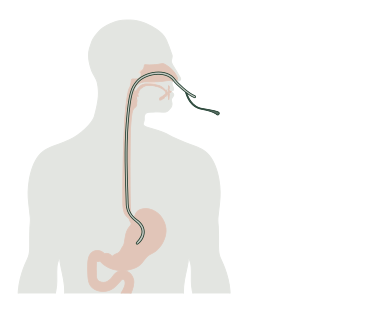
A Dobhoff tube is a soft, thin, weighted nasal feeding tube that goes through the nose and down to the stomach or the small intestine. It's a small-bore tube, which makes it more comfortable and better tolerated than a standard wide NG tube for feeding. Because the tip can end up in different places, its position must be confirmed by X-ray before anything is put through it. Dobhoff tubes are usually used short-term.
- A Dobhoff is a soft, thin, weighted small-bore nasal feeding tube for the stomach or small intestine.
- It's more comfortable and longer-wearing than a standard wide-bore NG tube.
- Its position must be confirmed by X-ray before it's used — the tip can sit past the stomach.
- The narrow bore clogs easily, so flushing well matters, and it's usually short-term.
If a nurse or doctor mentioned a "Dobhoff," you may have pictured a big, uncomfortable tube. It's actually the opposite — a Dobhoff is one of the softer, gentler nasal feeding tubes, and knowing what it is takes most of the worry out of it.
What a Dobhoff tube is
A Dobhoff is a soft, thin, weighted feeding tube that goes in through the nose and down to the stomach or the small intestine. The small weight at the tip helps it settle in the right place, and the material is flexible and narrow — a small-bore tube.
That narrow, soft design is the whole point: it's more comfortable and better tolerated over days to weeks than a standard wide nasal tube. If you'll be fed through your nose for a little while, a Dobhoff is often the kinder choice.
How it's placed, and where it ends up
A Dobhoff is usually placed at the bedside using a guidewire or stylet inside the tube to help guide it down. Once it's in, the guidewire is removed.
Where the tip ends up can vary:
- In the stomach — the most common position.
- Past the stomach, in the small intestine — sometimes called a nasojejunal (NJ) position, chosen when feeding directly into the intestine is better for you.
Because the tip can land in different places — and because a soft tube can occasionally go the wrong way — its exact position is confirmed by X-ray before it's used.
Why placement must be confirmed first
A newly placed Dobhoff must not be used for feeding, fluids, or medicine until your care team has confirmed its position (usually by X-ray). Feeding through a misplaced tube can be dangerous. If you're ever unsure whether yours has been confirmed, stop and ask.
This is the single most important thing to understand about a Dobhoff. The comfort and softness come with one rule: confirmation before use, every time it's newly placed.
Dobhoff vs a standard NG tube
Both go in through the nose, but they're built for different jobs:
- Dobhoff (small-bore) — soft, thin, weighted, made for feeding; more comfortable and better for longer wear.
- Standard NG tube (wide-bore) — wider and stiffer; can be used to feed but is also used to drain or empty the stomach.
The trade-off for the Dobhoff's comfort is its narrow bore, which clogs more easily.
Keeping it clear
Because a Dobhoff is so narrow, it can clog if it isn't kept clean. The main habit that prevents this is flushing with water before and after feeds and medicines, and giving medicines in liquid form where possible. See How to flush a feeding tube. Never force a clog through — see What to do about a clogged feeding tube.
Short-term by design
Dobhoff tubes are usually a short-term solution — days to a few weeks — while you recover or while a longer plan is worked out. If longer-term feeding is likely, your care team may talk with you about other options. See Types of feeding tubes.
When to call your care team
Reach out if you notice:
- Coughing, choking, or trouble breathing during or after a feed — treat this as urgent
- The tube looks longer than before, has slipped, or has come out partway
- The tube won't flush or feels blocked
- Nosebleeds, a sore throat, or skin breakdown where the tube is taped
For the bigger picture, start with What is an NG tube? and Feeding tubes made simple.
Frequently asked questions
- Enteral nutrition and feeding tube access — patient resources — American Society for Parenteral and Enteral Nutrition (ASPEN)
- Education and peer support for home tube feeding — The Oley Foundation
This article is educational and is not medical advice. Every person and every tube is different — always follow the instructions of your own care team, and call them (or emergency services) if something feels wrong.