Dobhoff vs NG tube: what's actually different
A Dobhoff is a kind of NG tube — but the word 'NG tube' covers very different tools. The plain-language difference between a Dobhoff, a standard NG feeding tube, and the big Salem sump drainage tube.
Written from the clinical sources listed below
On this page
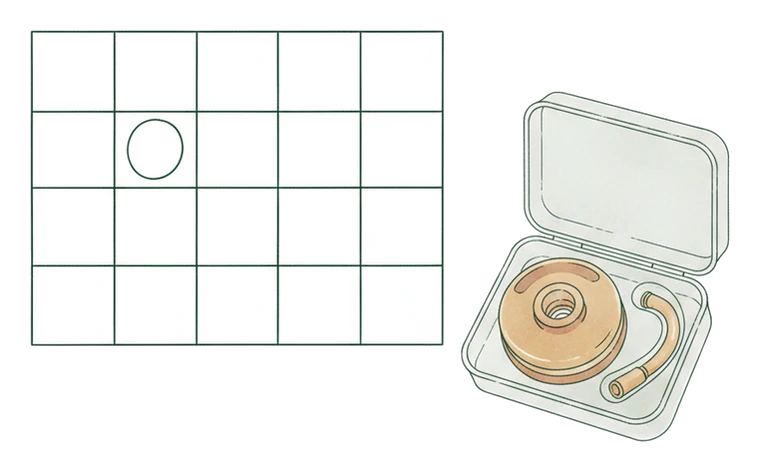
A Dobhoff is a type of NG (nasogastric) tube — a thin, soft, weighted one designed only for feeding and medicines. When people say 'NG tube' in a hospital they often mean a larger, stiffer tube like a Salem sump, which has a second channel and is used to drain or decompress the stomach. The practical difference: Dobhoff = small, comfortable, feeding only, clogs more easily; Salem sump = large, stiffer, can suction, not meant for long comfort. Which one you get depends on whether the goal is feeding you or emptying your stomach.
- 'NG tube' is the umbrella term — a Dobhoff is one specific kind: small-bore, soft, weighted, feeding-only.
- The big stiff double-channel tube used for stomach drainage is a Salem sump — a different tool for a different job.
- A Dobhoff is far more comfortable for living and feeding, but its narrow bore clogs easily and it can't suction anything.
- A Dobhoff needs a wire for insertion and an X-ray before first use; it should never be reconnected to suction.
- If you went home with a nasal feeding tube, it's almost certainly a Dobhoff-style small-bore tube.
Here's the confusion in one sentence: "NG tube" is a category, and a Dobhoff is one member of it — but hospital shorthand uses "NG tube" for the big stiff drainage tube too, so the same two words end up describing very different experiences. If you've been told you're "going home with an NG tube" after days with something uncomfortable taped to your nose, this article is the good news.
The three tubes people mean#
When someone says "NG tube," they usually mean one of three things:
- A Dobhoff-style small-bore feeding tube. Thin, soft, weighted tip, inserted with a removable wire. Built for one job: carrying formula, water, and medicines to your stomach or small intestine. This is the comfortable one — the one designed to be lived with.
- A standard single-channel NG tube. A middle ground — a simple tube sized for feeding, without the Dobhoff's weight and stylet. Common for shorter-term feeding, especially where placement is easy.
- A Salem sump. The large, stiffer, double-channel tube from hospital scenes: one channel connects to suction to empty or decompress the stomach, the little open second port (often a blue pigtail) vents air so the suction doesn't grab the stomach wall. It can feed in a pinch, but comfort was never the design goal.
Side by side#
| Dobhoff (small-bore) | Salem sump (large-bore) | |
|---|---|---|
| Main job | Feeding and medicines | Draining / decompressing the stomach |
| Thickness | Thin (about 8–12 Fr) | Thick (often 14–18 Fr) |
| Feel | Soft, flexible — designed to live with | Stiff — tolerable, not comfortable |
| Suction | Never | Yes, that's the point |
| Insertion | With a removable guidewire; X-ray before first use | Direct; placement checked per protocol |
| Clogging | Clogs easily — flush religiously | Rarely clogs |
| Typical setting | Feeding at home or on the ward, days to weeks | Hospital, usually short |
What this means for you day to day#
If you're the one with the Dobhoff, three practical rules follow from its design:
- Flush like it matters, because it does. The narrow bore is the price of comfort. 1 oz (30 mL) of water before and after every feed and every medicine, and between medicines.
- Liquid medicines beat crushed ones. Ask your pharmacist. A pill paste that a Salem sump would shrug off will end a Dobhoff.
- Check the nostril marking before every feed. A soft tube can migrate. Same number at the nostril = same place inside. If it's moved, stop and call your care team rather than feeding — and if anything through the tube triggers coughing, choking, or trouble breathing, stop immediately; severe breathing trouble is a 911 call, not a wait-and-see.
For the full daily routine — placement checks, feeding, the bridle, troubleshooting — see Dobhoff tubes: the complete guide.
Which one will you get?#
You don't really choose between these tubes — the job chooses. Stomach needs emptying: Salem sump. Body needs feeding and the need is temporary: small-bore feeding tube. Need lasting beyond a month or so: that's usually when the conversation moves to a G-tube, which bypasses the nose entirely.
Frequently asked questions
- Nasogastric tube — StatPearls — NCBI Bookshelf / StatPearls Publishing
- ASPEN safe practices for enteral nutrition therapy — American Society for Parenteral and Enteral Nutrition
- Initial and ongoing verification of feeding tube placement in adults (practice alert) — American Association of Critical-Care Nurses (AACN)
This article is educational and is not medical advice. It is written from the published clinical sources listed above, not from your own chart. Every person and every tube is different — always follow the instructions of your own care team, and call them (or emergency services) if something feels wrong.