What is a GJ tube? (gastrojejunostomy, explained)
A plain-language explanation of GJ tubes — a two-port tube reaching both the stomach and small intestine, why it's used, and how it differs from a G tube.
Reviewed by the Lugano Health team
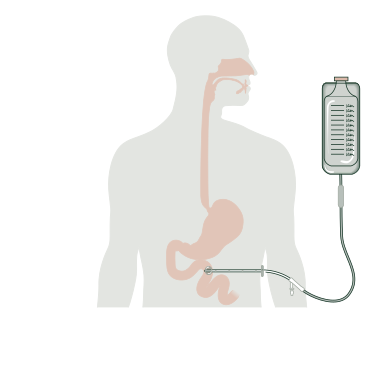
A GJ tube is a combination feeding tube that reaches two places at once. It goes in through a single opening in your abdomen but has two ports: a G port that opens into your stomach (often used for venting and some medicines) and a J port that carries feeds past the stomach into the small intestine (the jejunum). GJ tubes are used when the stomach needs to be bypassed for feeds — for example, with severe reflux, a high risk of aspiration, or poor stomach emptying.
- A GJ tube is one tube with two ports: a G port to the stomach and a J port to the small intestine.
- Feeds usually go into the J port; the G port is often used for venting gas and some medicines.
- It's chosen when the stomach must be bypassed — reflux, aspiration risk, or slow stomach emptying.
- Knowing which port is which matters — your care team will label them and tell you what each is for.
If you've just heard "GJ tube," it can sound like a whole new world. It's really a clever combination of two tubes you may already know about — and once you see how it works, the name makes sense.
What "GJ" stands for
GJ stands for gastrojejunostomy. Here's the plain translation:
- Gastro — stomach.
- Jejuno — the jejunum, a middle part of the small intestine.
- -ostomy — an opening.
Put together, a GJ tube reaches both the stomach and the small intestine through a single opening in your abdomen.
One tube, two ports
A GJ tube goes in through one site but splits into two separate ports, each with its own job:
- The G port opens into your stomach. It's often used to vent gas or drain the stomach, and sometimes to give certain medicines.
- The J port carries feeds past the stomach into the small intestine (jejunum).
The two ports are not interchangeable. Your care team will label them clearly and tell you what each one is for. Using the wrong port can mean feeds end up in the wrong place — so when in doubt, stop and check.
G tube vs GJ tube, at a glance
| G tube | GJ tube | |
|---|---|---|
| Where it reaches | Stomach only | Stomach and small intestine |
| Ports | One | Two (G and J) |
| Feeds usually go into | Stomach | Small intestine (J port) |
| Often used for venting? | Sometimes | Yes — via the G port |
For more on the plain G tube, see What is a J tube? and G tube vs J tube.
Why a GJ tube is used
A GJ tube is usually chosen when the stomach isn't a safe or reliable place for feeds, such as with:
- Severe reflux that doesn't settle with a stomach tube
- A high risk of aspiration (breathing feed into the lungs)
- Poor stomach emptying, where food sits too long in the stomach
Feeding into the small intestine can lower these risks while the G port still lets you vent the stomach for comfort.
Care basics
Day-to-day care is a little more involved than a plain G tube, but it becomes routine:
- Feeds are usually continuous or slow into the J port, since the small intestine can't hold large amounts at once — often given by pump.
- Flush regularly. The J channel is long and thin and can clog, so flushing before and after feeds and medicines matters. See How to flush a feeding tube.
- Keep the ports straight. Know which is G and which is J before you connect anything.
- Site care — keep the skin around the tube clean and dry.
When to call your care team
Reach out promptly if you notice:
- A port won't flush, or you feel strong resistance
- The tube looks longer, shorter, or out of position, or has come out
- Redness, swelling, warmth, leaking, or new pain at the site
- Nausea, vomiting, diarrhea, or a swollen belly during or after feeds
A displaced J or GJ tube needs prompt attention, because the internal position matters. New to all of this? Start with Feeding tubes made simple.
Frequently asked questions
- Enteral access and tube feeding — patient resources — American Society for Parenteral and Enteral Nutrition (ASPEN)
- Home tube feeding — education and peer support — The Oley Foundation
This article is educational and is not medical advice. Every person and every tube is different — always follow the instructions of your own care team, and call them (or emergency services) if something feels wrong.